For twenty years the case against American power was that it no longer worked: too slow, too visible, too easily absorbed by an adversary willing to wait. Two operations this year answered that. On 3 January a raid removed a sitting head of state from a fortified compound in Caracas in about two hours, without an American fatality. On 28 February the United States and Israel opened a campaign against Iran that killed Ali Khamenei on its first day.
Hal Brands, no partisan of this administration, called the Venezuela raid “an awesome display of the capabilities that make the US military the world's best by far.” The strategic gain is larger than the tactical one. Venezuela had been the open door in this hemisphere for Havana, Tehran, Moscow and Beijing, a place from which sanctions were evaded and networks run. It is shut, and every government in the region watched it close.
The oil follows the security, as it always has. Venezuelan output had fallen from about 3.5 million barrels a day in the 1990s to roughly one million, and American imports from it to 120,000 barrels a day in January. Restoring those fields to their early-2010s level is reckoned to need 80 to 90 billion dollars of investment over six or seven years. That is a business proposition, and it is now open to firms that answer to shareholders rather than to shadow tankers bound for China.
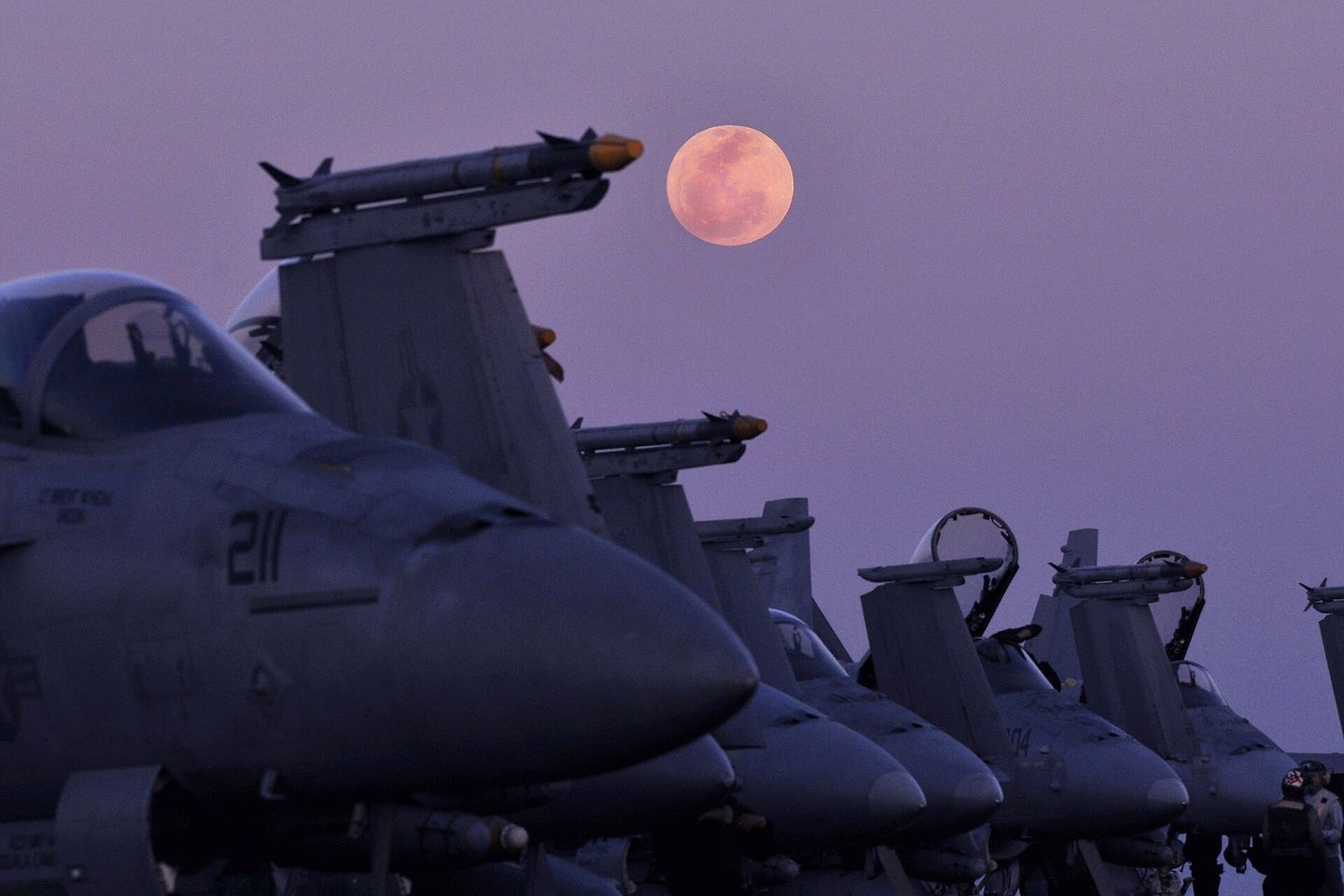
Deterrence is not a mood. It is a demonstration, and the demonstration is paid for in magazines, not in adjectives.
Here is the part of this reading its critics never expect to hear. The year exposed a hollowness no amount of resolve can fix. Analysts at the American Enterprise Institute have argued that the stocks drawn down in the Iran war are a strategic red flag, the product of three decades of buying exquisite systems instead of production depth. Expanding a missile line takes years from contract award. Willingness was never the binding constraint. Capacity is.
That is what the 1.5 trillion dollar request for 2027 is actually for. It is a 24 per cent real increase in discretionary funding over 2026, 38 per cent counting the 350 billion sought through reconciliation, and the largest single-year defence figure since 1945. Measured against the economy it is 3.6 per cent of GDP in outlays against 3.0 last year, well under the Cold War average. It is a catch-up payment on a deferred bill, not an indulgence.
The allies are paying too, which is the vindication almost nobody predicted. European members and Canada added 139 billion dollars in core defence spending in a single year, a rise of about a fifth, and at Ankara in July committed to 5 per cent of GDP by 2035, of which 3.5 is core defence. Twenty years of polite communiques produced nothing comparable. One year of being told the guarantee was conditional produced this.
The honest risk is the one Brands names: Beijing is studying the same tape. A blockade followed by decapitation is a method, and methods travel. The answer is not to stop demonstrating that American force works, which is the only thing that has ever deterred anybody for long. It is to make certain the magazine behind the demonstration runs deep enough that no one is tempted to find out how shallow it is.